

Do you want to successfully start a jojoba oil wholesale business in 2026 or grow your current trade? The market for natural oils is growing rapidly and offers plenty of opportunities for visionary entrepreneurs. In this guide, you will discover everything you need to know about jojoba oil wholesale, from current market trends to practical purchasing strategies. You will learn how to ensure quality, manage smart logistics, and comply with all regulations. With concrete tips, clear steps, and inspiring examples, you will get the tools to differentiate your business and thrive in a competitive market.
Jojoba Oil Market Analysis 2026: Trends & Opportunities
The jojoba oil wholesale market is rapidly transforming towards 2026. Worldwide demand for natural oils is growing, especially in the cosmetics and personal care sectors. Entrepreneurs who explore this market now can benefit from unique growth opportunities. Below is an in-depth analysis of the main trends and target audiences.
Growth of the Global Jojoba Oil Market
The global market for jojoba oil wholesale shows impressive growth. An annual growth rate (CAGR) of 7 to 10 percent is expected until 2026, driven by the increasing popularity of natural cosmetics and hair care products. Especially organic and cold-pressed jojoba oil are in demand among both producers and consumers.
Sustainability and traceability have become important themes within the jojoba oil wholesale market. More and more companies demand full transparency about origin and production chain. This directly affects the price and positioning of jojoba oil wholesale products.
Regional differences are clearly visible. Europe is considered one of the strongest growth regions, with the Netherlands, Germany, and France as leaders. Growing consumer awareness plays a major role here, especially regarding natural ingredients and environmentally friendly production.
The rise of private label initiatives within the jojoba oil wholesale market leads to more competition and innovation. Brands seek differentiation through unique formulations and sustainability claims. According to Jojoba Oil Market Trends 2024, consumers are becoming increasingly critical of quality and purity, requiring wholesalers to stand out with certified products.
The trend towards vegan, cruelty-free, and eco-friendly products is evident from the increase in labels and certifications within the jojoba oil wholesale market. Companies that respond to this trend increase their market share and build a strong brand image.
Main Markets and Target Audiences
For jojoba oil wholesale, the biggest opportunities lie with both B2B and B2C customers. Within B2B, especially cosmetics manufacturers, spas, wellness chains, and specialized retailers are important buyers. They seek reliable suppliers who can meet high quality and certification standards.
B2C markets offer opportunities for brands focusing on natural skin and hair care, DIY producers, and niche markets. Think of vegan, cruelty-free, and eco-friendly labels that cater to the preferences of conscious consumers. European consumers spend over 1 billion euros annually on natural oils, with jojoba oil wholesale taking an increasingly larger share.
New niches are emerging quickly. For example, demand is growing for jojoba oil wholesale products for men's care, baby care, and niche perfumery. These segments require specific product features, packaging, and storytelling. Private label and white label solutions make it possible to respond quickly to these trends.
An overview of target groups within jojoba oil wholesale:
| Target audience | Features | Opportunities |
|---|---|---|
| Cosmetics manufacturers | High volumes, strict requirements | Private label, long-term relationships |
| Spas & wellness chains | Premium segment, quality focus | Natural products, eco-labels |
| Retailers (B2B & B2C) | Wide assortment, competitive price | Volume discounts, fast delivery |
| Niche brands | Unique composition, storytelling | Small batches, innovation |
The diversity of sales markets calls for a flexible strategy within the jojoba oil wholesale business. By carefully listening to the needs of different target groups, wholesalers can tailor their offerings precisely to market demand.
Quality & Certification: What to Look for When Purchasing?
Ensuring quality and certification is crucial for success in the jojoba oil wholesale market. Every step, from selection to delivery, determines your customers’ trust and the final value of the product.
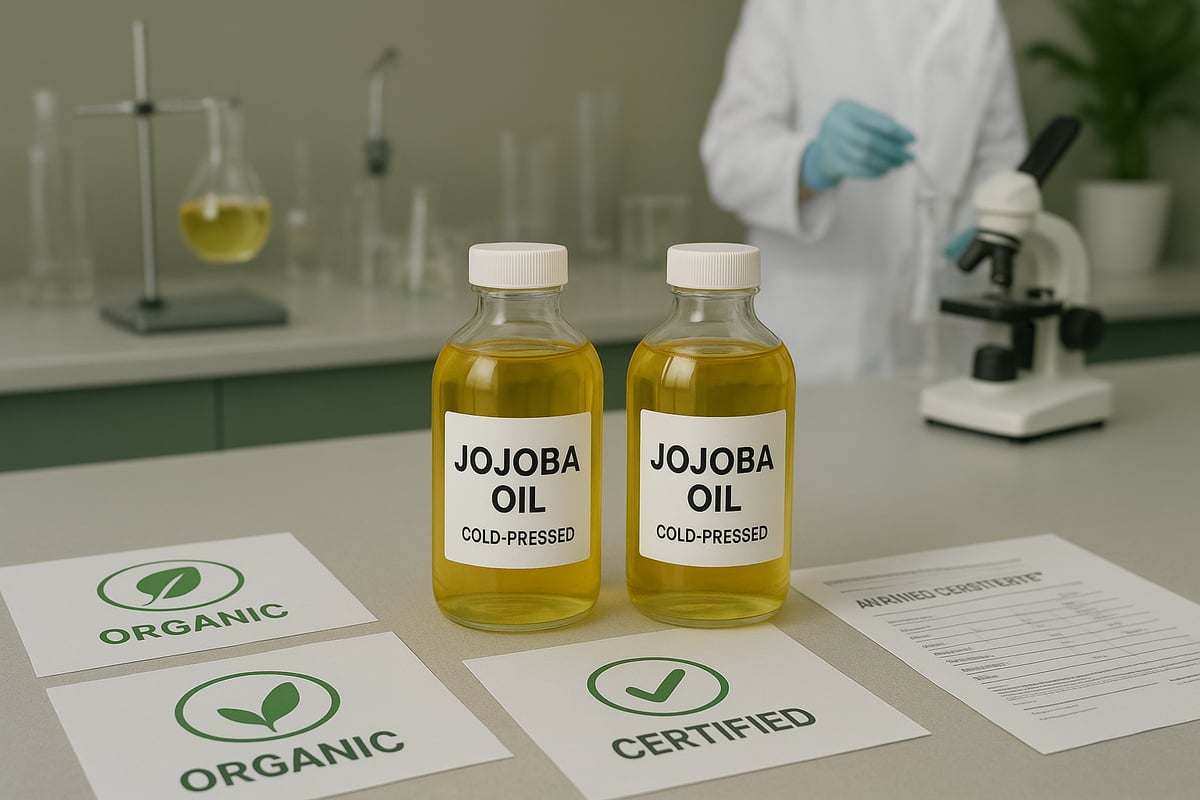
Requirements for jojoba oil wholesale
Those focusing on the jojoba oil wholesale market know that quality is fundamental. First and foremost, it is essential that the oil meets the INCI specification: Simmondsia Chinensis Seed Oil. This guarantees that you are purchasing the correct, pure product.
Organic certification is essential for many B2B customers. Think of EU Organic or USDA Organic. These certificates prove that the oil is produced without harmful chemicals. For the highest quality, choose cold-pressed jojoba oil. Unlike refined oil, the full profile of active substances is preserved. Want to understand the difference well? Then read the article about the difference between cold-pressed and refined oil.
Origin and traceability play an increasingly important role in the jojoba oil wholesale market. Suppliers must be transparent about where and how the oil is produced. Always request laboratory reports such as PDS (Product Data Sheet), SDS (Safety Data Sheet), and CoA (Certificate of Analysis). This allows you to verify purity, composition, and absence of allergens.
Ensure the oil is free from synthetic additives and that batch variations due to seasonal influences are well monitored. Regularly test small batches before purchasing on a large scale. This prevents surprises and guarantees consistent quality within your jojoba oil wholesale business.
Documentation and certifications
Complete documentation is essential for a professional jojoba oil wholesaler. B2B customers expect access to all relevant documents, such as:
- IFRA certificates
- Allergen lists
- Safety data sheets (SDS)
- Analysis certificates (CoA)
- Organic certificates
Quality marks contribute to customer trust and enable higher selling prices. Many buyers pay attention to EU Organic, USDA Organic, Ecocert, and Vegan Society. These certifications are not only proof of quality but also offer a marketing advantage.
A practical example: a cosmetics manufacturer chose a jojoba oil wholesaler with extensive certification. This allowed the brand to position its products directly as organic and vegan, resulting in higher margins and faster market access.
Make sure your documentation is always up to date and available during audits or customer inquiries. This prevents delays and strengthens your position as a reliable player in the jojoba oil wholesale market.
Jojoba Oil Purchasing Plan for Wholesale (2026)
Do you want to achieve immediate results as an entrepreneur in the jojoba oil wholesale market in 2026? This step-by-step plan gives you a clear overview of the entire purchasing process. By carefully going through each part, you minimize risks and maximize returns. This way, you build a sustainable and profitable jojoba oil wholesale business.

Step 1: Market orientation and supplier selection
The first step for a successful jojoba oil wholesale business is thoroughly exploring the market and selecting reliable suppliers. Don’t just look at price, but especially at certification, references, and delivery history.
- Check whether suppliers meet organic and quality standards.
- Compare suppliers from different regions, such as South America and Israel. Pay attention to origin, as this affects price and quality.
- Ask for customer reviews and check delivery reliability through independent platforms.
A good supplier selection forms the foundation of your jojoba oil wholesale business. This prevents unexpected delivery problems and ensures continuity.
Step 2: Requesting Quotes and Price Comparison
Request quotes from multiple parties for jojoba oil wholesale volumes. Analyze not only the price per kilogram but also additional costs.
- Watch for transport costs, customs duties, and insurance.
- Compare tiered prices: bulk prices often range between €13.66 and €24.95 per kg, depending on volume and origin.
- Use an overview table for an objective comparison of European versus international suppliers.
Below is a sample table:
| Supplier | Price/kg | Transport | Certification | Total Costs |
|---|---|---|---|---|
| Europe | €18,50 | €1,00 | EU Organic | €19,50 |
| South America | €15,00 | €3,00 | USDA Organic | €18,00 |
With a structured price comparison, you make the right choices for your jojoba oil wholesale business.
Step 3: Quality Control and Sample Analysis
Quality is essential in the jojoba oil wholesale business. Always request samples before placing a large order. Have them analyzed for scent, color, viscosity, and purity.
- Test small batches in your own production process.
- Check laboratory reports such as PDS, SDS, and CoA.
- Watch for batch differences, especially with natural harvests and seasonal influences.
Compare samples from different suppliers to ensure your jojoba oil wholesale business only delivers top quality. A thorough check prevents complaints and returns.
Step 4: Contract Agreements and Delivery Terms
Put all agreements with your supplier in writing. Important points include delivery times, return policy, and liability. Negotiate payment terms, such as advance payment or on account.
Private label or white label production often has specific requirements. If you want to know how to start your own brand, read the Private Label Essential Oils Guide.
Clear contract agreements provide certainty and strengthen your position as a jojoba oil wholesaler.
Step 5: Logistics, Storage, and Inventory Management
Good logistics and storage are crucial for the jojoba oil wholesale business. Store the oil in a cool, dark, and airtight place to prevent oxidation and quality loss.
- Implement batch registration and the first-in-first-out principle.
- Plan your inventory based on seasonal influences and expected demand.
- Ensure flexible storage space for fluctuations in supply.
With smart inventory management, your jojoba oil wholesale remains flexible, preventing spoilage or shortages. This way, you can respond immediately to market opportunities.
[Jojoba Olie Groothandel bij Oliemeesters: Kwaliteit & Service] (https://groothandelolie.nl)
Are you looking for a reliable partner for your jojoba oil wholesale? Oliemeesters is the specialist for organic and cold-pressed jojoba oil, delivered with maximum service and transparency. Thanks to years of experience and a keen eye for quality, you can be sure you are investing in a product that meets the highest standards in wholesale.
![[Jojoba Oil Wholesale at Oliemeesters: Quality & Service] (https://groothandelolie.nl)](https://xqvnmkjynbkcujcrtubi.supabase.co/storage/v1/object/public/article-images/34d356c1-19ea-4a72-9482-746131f978d7/article-34d356c1-19ea-4a72-948-een-realistische-hoge-kwaliteit-foto-van-een-moder-3-knwge0.jpg)
Advantages of jojoba oil wholesale at Oliemeesters at a glance:
| Feature | Description |
|---|---|
| Organic | EU Organic & USDA Organic certified |
| Cold-pressed | Maximum purity and effectiveness |
| Vegan & Cruelty-free | No animal or synthetic substances |
| Traceable to the source | Complete transparency in the supply chain |
| Wide assortment | From 500 ml to 190 kg drums |
| Volume discount | Competitive prices for larger volumes |
Oliemeesters offers both B2B and B2C solutions for jojoba oil wholesale. You benefit from fast delivery within 1 to 5 working days throughout the EU. For brands and resellers, there are private label and white label options, allowing you to easily launch your own line of natural care products with guaranteed quality.
Customers highly appreciate Oliemeesters' jojoba oil wholesale, as evidenced by more than 600 positive reviews and a high customer satisfaction score. Additionally, you receive free shipping on orders over €95 within the Netherlands, Belgium, and Germany. All product documentation, certificates, and support are immediately available, ensuring you meet all requirements for safe and transparent trade. Want certainty about delivery terms and contract agreements? Feel free to check the Oliemeesters General Terms and Conditions.
A practical example: an emerging cosmetics brand chose jojoba oil wholesale through Oliemeesters. Thanks to the private label service and flexible tiered pricing, the brand was able to scale quickly and successfully launch its products on the market. This proves that Oliemeesters combines quality, reliability, and customer-focused service to drive growth in the dynamic jojoba oil wholesale market.
Laws and Regulations for Jojoba Oil Wholesale (EU & International)
The success of a jojoba oil wholesaler depends entirely on knowledge of the complex laws and regulations. European and international rules determine whether your products can be legally and safely brought to market. Especially in this growing sector, compliance is a prerequisite for sustainable growth and customer trust.
European and international requirements
The European market imposes strict requirements on the jojoba oil wholesale business. The EU Cosmetics Regulation (EC) No. 1223/2009 forms the basis for all cosmetic products, including jojoba oil. This legislation requires every wholesaler to register their products via the Cosmetic Product Notification Portal (CPNP) before they can be sold. This ensures transparency and traceability within the supply chain.
Labeling must include clear details:
- INCI name: Simmondsia Chinensis Seed Oil
- Batch number and expiration date
- Allergens and warnings
- Name and address of the responsible party
Importers of jojoba oil wholesale must pay extra attention to customs rules, organic certification, and proof of origin. Since Brexit, the rules for import/export with the UK have changed, bringing additional administrative burdens and inspections. For international trade, it is crucial to comply with both European and local requirements so that products are not held up at the border.
A properly documented product prevents delays and gives customers confidence. Make sure certificates such as EU Organic or USDA Organic are up-to-date and can be presented immediately during inspections.
Compliance and risks
Non-compliance with regulations poses significant risks for a jojoba oil wholesaler. Possible consequences include fines, product recalls, or even reputational damage. This can cause major financial harm and threaten the continuity of the business.
It is important for a wholesaler to stay up-to-date with all relevant requirements. Regular audits, training, and collaboration with specialized consultants help minimize risks. Use a checklist for quality documentation such as PDS, SDS, and CoA, so you are always prepared for inspections.
| Risk | Consequence | Solution |
|---|---|---|
| Incomplete labeling | Fine, recall | Check labels per batch |
| No CPNP registration | Sales ban | Always register on time |
| Outdated certificates | Trust declines | Annual update of all documents |
Transparency and documentation are keys to compliance. During audits, you must be able to immediately show all relevant papers. This way, your jojoba oil wholesale business builds a reputation for reliability and quality. Follow current developments through industry organizations to be prepared for changes in legislation.
Success Tips for Jojoba Oil Wholesale in 2026
Want to strengthen your position in the jojoba oil wholesale market in 2026? By strategically investing in positioning, customer relationships, innovation, pricing, inventory management, and data, you can grow your business sustainably. These tips help you get the most out of the market.
Positioning and marketing
In a competitive jojoba oil wholesale market, differentiation is key. Make sustainability, transparency, and a clear story central to your marketing strategy. Consumers and B2B customers look for suppliers who not only deliver quality but also demonstrate social responsibility.
- Tell the story behind your organic, cold-pressed oil.
- Display certificates and origin clearly on your website.
- Use storytelling to build trust.
Market analysis shows that brands with a strong focus on sustainability grow faster. Want to learn more about market trends and growth opportunities? Check out the jojoba oil market overview up to 2030.
Customer relationships and aftersales
Long-term relationships form the foundation of a successful jojoba oil wholesale business. B2B customers expect not only a quality product but also personal service and fast communication.
- Respond to quote requests within 24 hours.
- Deliver orders quickly and accurately.
- Actively ask for feedback and improve your processes.
A good aftersales strategy ensures customers return and recommend you to others. This increases customer satisfaction and drives organic growth.
Innovation and product development
Keep responding to trends like vegan, zero waste, and multifunctional uses. In the jojoba oil wholesale market, private label and co-creation with customers offer unique opportunities to enter new markets.
- Develop niche products, for example for men's care or baby care.
- Collaborate with customers on innovative formulas.
- Introduce sustainable packaging.
According to recent market insights, demand for innovative jojoba oil applications continues to rise sharply. For more in-depth analysis, see the jojoba oil market report with trends and forecasts up to 2030.
Pricing strategy and margin optimization
A smart pricing strategy is essential for every jojoba oil wholesaler. Use volume discounts and bundle offers to increase your margin and encourage customers to buy larger volumes.
| Strategy | Benefit | Example |
|---|---|---|
| Volume discount | Higher purchase, better margin | 5% discount >100kg |
| Bundle offers | Sale of multiple products | Set of 3 oils |
| Direct import | Lower price, more control | Self sourcing |
Regularly compare your prices with competitors and analyze your margins per product group.
Inventory and risk management
Flexible inventory management helps you quickly respond to seasonal influences and market fluctuations within the jojoba oil wholesale business. Work with minimum and maximum stock levels and carefully record batches.
- Use the first-in-first-out principle.
- Replenish stock based on historical sales data.
- Monitor shelf life and batch differences.
Smart inventory management prevents spoilage and minimizes capital tie-up.
Data and statistics
Data form the backbone of a modern jojoba oil wholesale business. Analyze sales figures, customer behavior, and market developments to optimize your purchasing and marketing.
- Use dashboards for real-time insight.
- Prepare monthly reports.
- Keep an eye on industry figures for benchmarking.
According to industry research, European jojoba oil wholesalers achieve an average annual turnover of several million euros. By working data-driven, you always stay one step ahead of the competition.
Common Mistakes & How to Avoid Them
Making mistakes is human, but in the jojoba oil wholesale business, they can have major consequences for your reputation, margins, and customer satisfaction. By gaining insight into common pitfalls and applying the right preventive strategies, you avoid unnecessary risks and build a stable trading position.
Typical pitfalls
The jojoba oil wholesale business faces specific challenges. One of the most common mistakes is purchasing jojoba oil without thorough quality control or valid certification. This often leads to products with impurities or allergens, posing risks to customers and end users.
Additionally, we see that insufficient knowledge of current regulations can result in incomplete documentation or incorrect labeling. This can not only lead to fines or recall actions but also damage claims in case of allergic reactions. A practical example: a wholesaler imported oil without clear batch registration, after which customers experienced allergic reactions due to traces of nut oil.
Poor supplier selection is another pitfall. Without checking references or laboratory reports, batches of jojoba oil of low quality or with synthetic additives may be delivered. Incorrect storage, such as exposure to light or heat, can also lead to oxidation and quality loss. In the worst case, this results in spoilage, making an entire batch unusable.
Finally, some companies forget to anticipate market developments. Insufficient inventory management or responding too late to trends, such as the growing demand for vegan and organic products, can result in missed opportunities. A thorough market analysis, such as found in the Jojoba Oil Market: Global Analysis and Forecast to 2035, helps to timely identify these changes in the jojoba oil wholesale market.
Preventive strategies
Fortunately, there are effective methods to prevent these mistakes within the jojoba oil wholesale business. Always start with a comprehensive checklist for purchasing and quality control. Request laboratory reports, check certifications, and verify the origin of the oil. This prevents surprises and ensures the purity of your products.
Invest in regular training and further education for staff. Knowledge of the latest regulations, labeling requirements, and audit procedures is crucial to remain compliant. Use reliable partners and suppliers with a proven track record and positive customer reviews. Request references and assess delivery history to minimize risks.
Implement a clear inventory and batch registration system. This makes it possible to quickly trace any complaints or recalls. Use the first-in-first-out principle to prevent spoilage and always maintain optimal storage conditions.
Learning from mistakes is valuable. Companies that, for example, received a damage claim due to incorrect labeling often improved their processes by adding extra checks. By consistently applying these preventive strategies, you build a healthy and successful jojoba oil wholesale business.
Now that you know exactly what to look for when purchasing jojoba oil and which steps will make you more successful as a wholesaler, it’s time to take the next step. At Oliemeesters, you benefit from 100% pure, organic, and cruelty-free jojoba oil, with fast delivery and transparent service. Whether you are just starting out or want to expand your existing range, we are ready to support you with reliable quality and flexible packaging. Want to experience how simple and fast your purchasing process can be? Order now – fast delivery within 1-5 days
Article written using RankPill.